+603 2201 9968
  support@cochok.my
What type of organisation is best for your business – Local Entrepreneur?
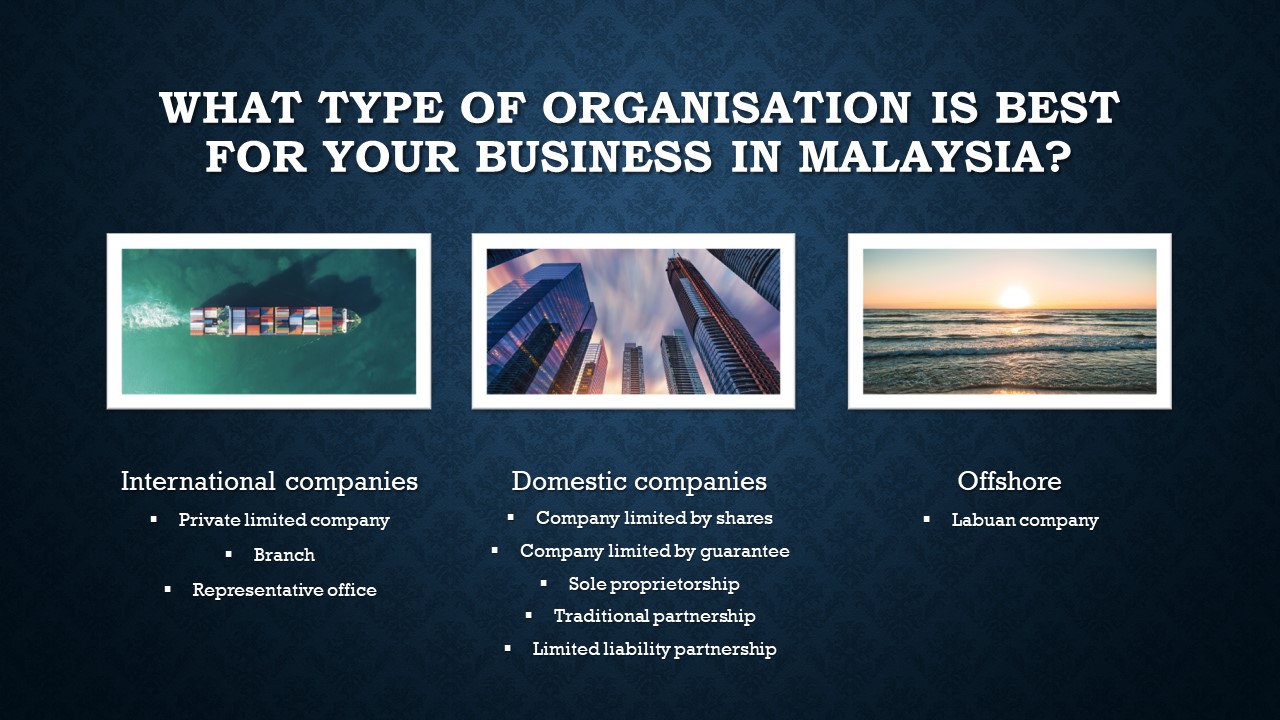
Once you have decided to start out a business, you will need to choose a type of organisation to run the business in Malaysia. There are several type of organisations that can be used as a vehicle to operate a business for local entrepreneur, namely:
- Sole proprietorship;
- Traditional Partnership;
- Limited company;
- Limited Liability Partnership.
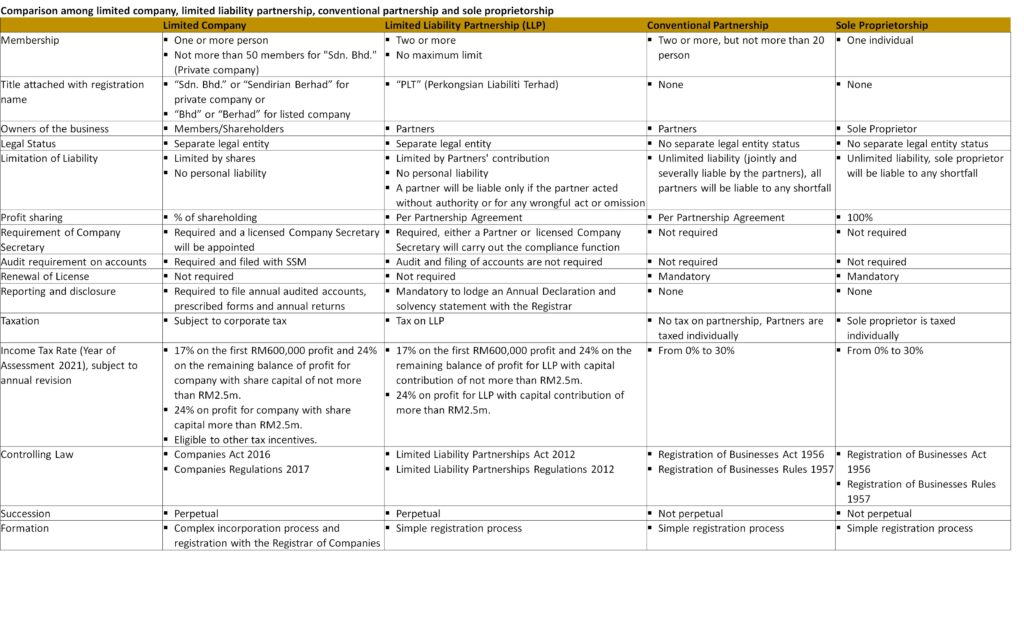
As each of the type of organisation will have its pros and cons and different registration process, you should have a good understand of each type of organisation before deciding which should best carry your business. Below are brief descriptions of each of the form of organisations. We have also provided a comparison table for ease of reference.
Sole proprietorship and Traditional Partnership
These forms of organisation are commonly used as vehicle for any new start up as they are the simplest forms in registration and lowest subsequent maintenance cost. Sole proprietorship represents a business owned by an individual, whereas, a partnership should be use if the business has more than one owner. Partnership may or may not have a partnership agreement drawn up to govern the organisation. The main shortfall of these forms of organisations is that the owner/partners are personally liable (partnership will jointly liable) to all debts and obligations arising from the business. Thus, these forms are not suitable to any high liability or high risk businesses.
Owner/partner of these forms will enjoy all profit or loss arising from the business and owner/partner will be individually taxed. Personal income tax could be higher than corporate income tax if income reaches certain threshold. Any departure of owner/partner from the business may result in dissolution of the business unless certain business continuation agreement is in place.
Limited company
A limited company is a common form of business in Malaysia as it provides separate legal entity status and limit its shareholders’ liabilities by their shares investment. Shareholder of a limited company will not be personally liable to the liabilities of a limited company. A limited company is also widely accepted by investors and banks and therefore, allows a business to raise funds easier.
There are two types of limited company in Malaysia: 1) limited company with suffix of Sendirian Berhad represents a private exempt company, it can have up to 50 shareholders; 2) suffix of Berhad represents a public exempt company and can have unlimited shareholders.
Its formation and business operation are governed by the Companies Act 2016 and Companies Commission of Malaysia (“Registrar”). To set up a limited company, a minimum of 1 member and 1 director residing in Malaysia are required. The Registrar allows most of the limited company to be 100% owned by foreigner. There are more requirements and higher costs to set up a limited company than other business forms. A limited company will also incur higher annual maintenance cost than other business forms due to the statutory requirements under the Companies Act 2016, for example, a limited company is required to file an audited financial statements with the Registrar and appoint a qualified company secretary.
A limited company is subject to corporate income tax, governed by the Income Tax Act 1967 and provides more tax incentives than all other form of organisation ie First RM600,000 profit will be subject to lower tax rate of 17% and remaining at 24% for a limited company with share capital of less than RM2.5m; investment tax allowance and so on. Tax incentives, grants and loan from the government are normally extended to limited company, not to other type of organisation.
Limited liability partnership (“LLP”) (Perkongsian Liabiliti Terhad)
LLP was an additional form of organisation introduced under the Limited Liability Partnership Act by the Companies Commission of Malaysia (“Registrar”) in 2012, and is a hybrid of limited company and traditional partnership. LLP provides the flexibility of controlling a business through internal arrangement while enjoying the limited liability status to its partners. Further, the registration/formation of a LLP is simpler and lesser cost than a limited company.
Similar to “limited company”, LLP is a body corporate and has legal personality separate from its partners (separate legal entity). Any change in partners of the LLP will not affect the existence, rights or liabilities of the LLP.
A LLP will be required to appoint a compliant officer and keep proper records ie details of partners; accounting records; LLP agreement; notice or certificate issued by the Registrar; and so on. A partner (residing in Malaysia) of the LLP or a qualified company secretary in Malaysia can be appointed as a compliant officer of the LLP. The compliant officers should register themselves with the Registrar upon their appointment. Different from a limited company, a LLP is not required to have its financial statements audited and filed with the Registrar. The LLP will only require to lodge an Annual Declaration that the LLP is able or not able to pay its debts in the normal course of business.
LLP may receive lower credit rating from vendors and financial institution due to its none statutory filing and audit of financial statements. As mentioned in preceding paragraph, LLP is not eligible to a number of tax incentives extended to limited company.